

Banknote Poland 20 Zloty (20 PLN) UNC
The 20-zloty banknote is a modern means of payment, combining aesthetics with advanced security technologies. Its dimensions are 126 x 63 mm, and the design references King Bolesław I the Brave, symbolizing the beginnings of the Polish state and its rich cultural heritage.
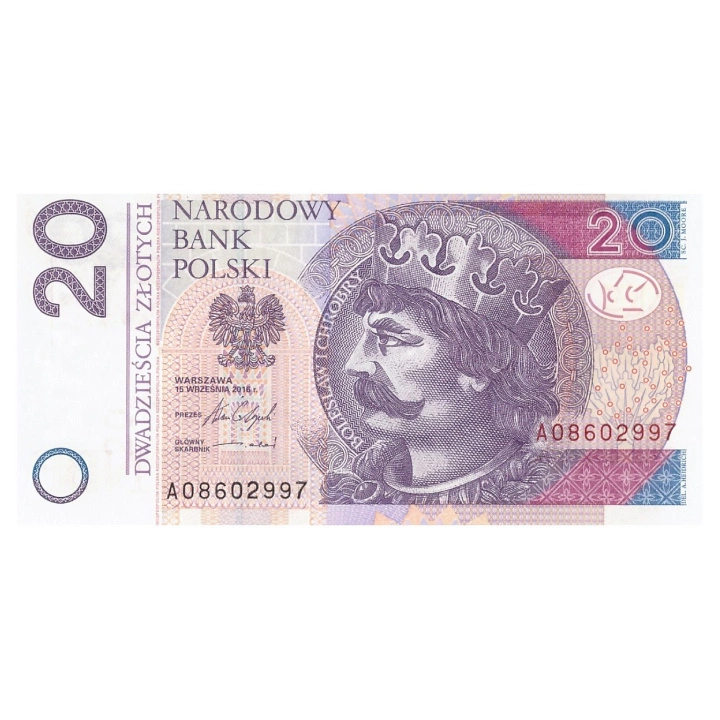
Obverse of the 20-zloty banknote features a portrait of King Bolesław I the Brave, surrounded by elements referring to his reign. On the left, a Romanesque portal is visible, while on the right the crown of a young oak from the Gniezno Doors, depicting the scene of the laying out of St. Adalbert’s body. Numerous security features are used, including a watermark with the ruler’s image and the denomination “20,” as well as tactile elements adapted for the visually impaired.
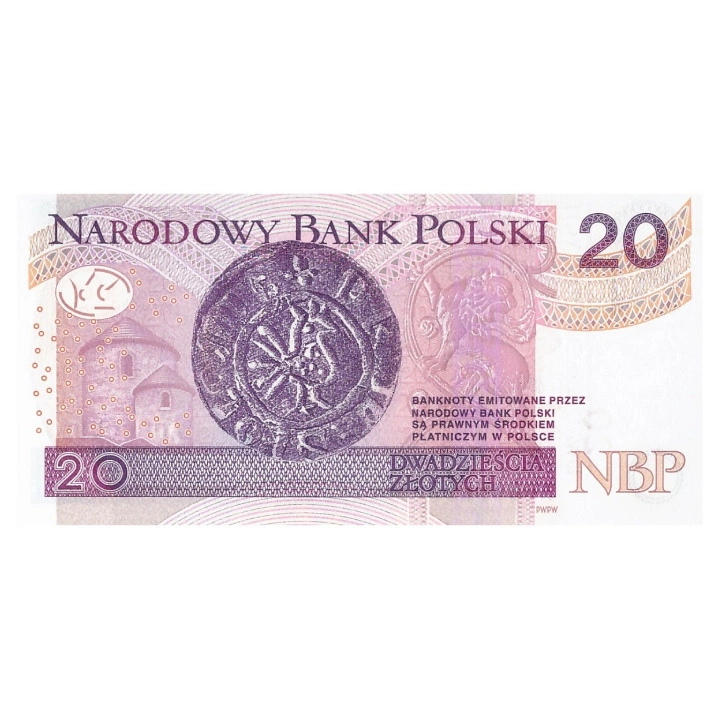
Reverse shows a silver denarius of Bolesław I the Brave with the silhouette of a bird and the inscription “PRINCES POLONIE.” On the left is the Rotunda of St. Nicholas in Cieszyn, and on the right a stylized lion from the border of the Gniezno Doors. Additional security features include an iridescent stripe and microprinting.
Security features:
Watermark: Image of the ruler and the denomination “20”.
Security thread: Vertical thread with the inscription “20 ZŁ,” visible when held up to the light.
Iridescent stripe: Stylized lilac-colored stripe with the denomination.
Recto-verso: Graphic elements on both sides form a complete image of a crown when viewed against the light.
Tilt effect: The “20” numerals change visibility depending on the viewing angle.
Microprinting: Precise inscriptions visible under magnification.
Covert features: Elements visible under UV light, including denomination markings and numbering.
The 20-zloty banknote combines aesthetics with modern technologies, ensuring a high level of protection against counterfeiting.
Important!
This item is sold as a currency-exchange transaction and the purchased means of payment is not returnable. When purchasing banknotes where the title or product specification does not specify particular features such as serial number, special marks (if any), year of issue, or design version, the banknotes are dispatched at random with respect to these parameters, without the possibility of selection by the buyer. The customer cannot choose the year of issue, serial number, special marks, a state of preservation other than that indicated in the product description, or the design version (e.g., in the case of EUR banknotes—new and old designs, or GBP banknotes—portraits of the king or the queen). All of the above rules apply to transactions for the purchase of the listed means of payment.
Banknote condition: UNC. The image is for illustrative purposes.