
The Queen’s Beasts: Griffin of Edward III 1/4 oz Gold 2017
The griffin - a mythical animal most often depicted with the body of a lion and the head and wings of an eagle. Some sources also add the ears of a wild donkey. At first, the griffin appears in art, much later in literature, and significant differences between descriptions of the griffin and its depiction can be seen. The earliest depictions come from ancient Mesopotamia from around 3000 BC, at the same time the motif appeared in Egypt. It reached Europe around 1600 BC via the islands of Crete and Cyprus. The first written mention of griffins dates from around the 5th century BC. The griffin often features in heraldry, according to some authors, in this respect second only to the lion. It is often chosen as a coat of arms because of its combination of the best features of two other creatures appearing in coats of arms - the lion and the eagle. As John de Bado Aureo wrote in Tractatus de armis (late 14th century): 'The griffin on the shield signified that the person bearing it was a strong man in whom could be found two natures and qualities, the eagle and the lion.' Symbolism attributed many virtues to griffins, including speed (eagle), strength (lion) and vigilance (donkey ears), as well as bravery, courage and perseverance. At the same time, they were also attributed negative traits such as greed or pride. Christianity also adapted the griffin as a symbol of Christ - its divine and human nature (lion and eagle).
*
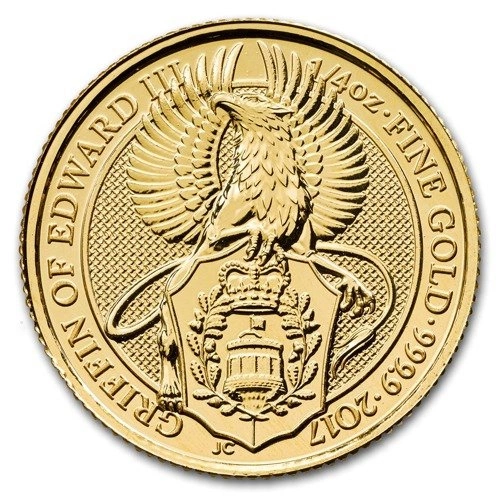
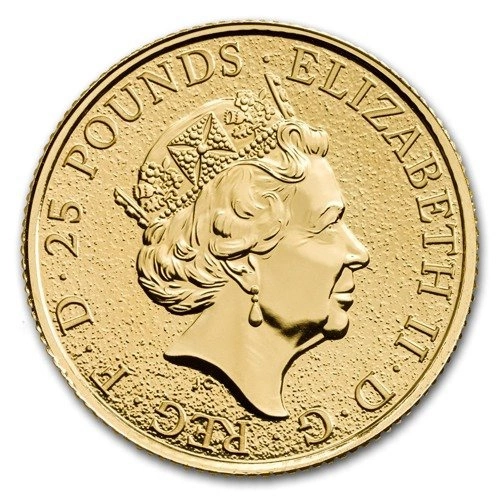
Obverse: The obverse features an image of Queen Elizabeth II designed by Jody Clark. We can also find here the denomination information (£25). The reverse: features a stylised image of the Griffin , as well as information on the weight (1/4 oz), the proof (0.9999) and the year of issue (2017).


