

Fiji Taku 1/2 oz Silver 2012
This turtle is not very distinctive from its relatives. Like them, it has a flattened body, a protective carapace and swimming-adapted limbs. However, it is distinguished by its long, downward curving beak and the clearly defined edges between the shell elements. Most sea turtles live in the open waters of the oceans, while the chinstrap turtle resides at all times in shallow lagoons and coral reefs, where it feeds on its favourite food - sea sponges. Some of these are highly toxic and eating them by other organisms would lead to their death. In addition, some sponges contain silica, so it is known that the chinstrap turtle is also one of the few creatures capable of eating animals whose bodies consist largely of silicon dioxide. It sometimes supplements its diet with small fish, molluscs, caecilians and jellyfish.The only sculpture depicting a tortoiseshell turtle is that of a boy riding a turtle, commonly known as ''Turtle Boy''. It stands in the main square in Worcester, Massachusetts, USA. It is also depicted on the reverse of a 20 Venezuelan bolivar coin and the reverse of a 2 Brazilian real note."
*
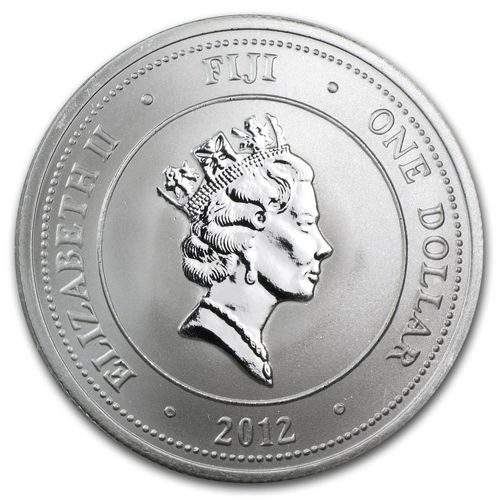
The obverse of the coin is decorated with the likeness of Queen Elizabeth II with a crown on her head. On the obverse we can also find information about the year of the coin's minting (2012) as well as the denomination ($1) and the country of origin (Fiji)
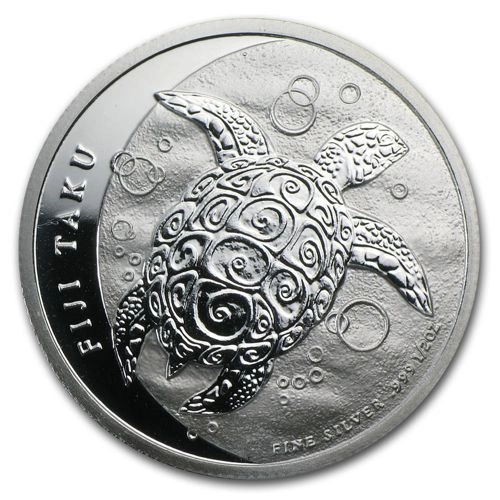
On the reverse is an effigy of a tortoiseshell turtle, also known as Taku, swimming along the ocean floor amidst tiny bubbles. The reverse also features information about the silver sample (999) and the weight of the coin (1/2 ounce)
"